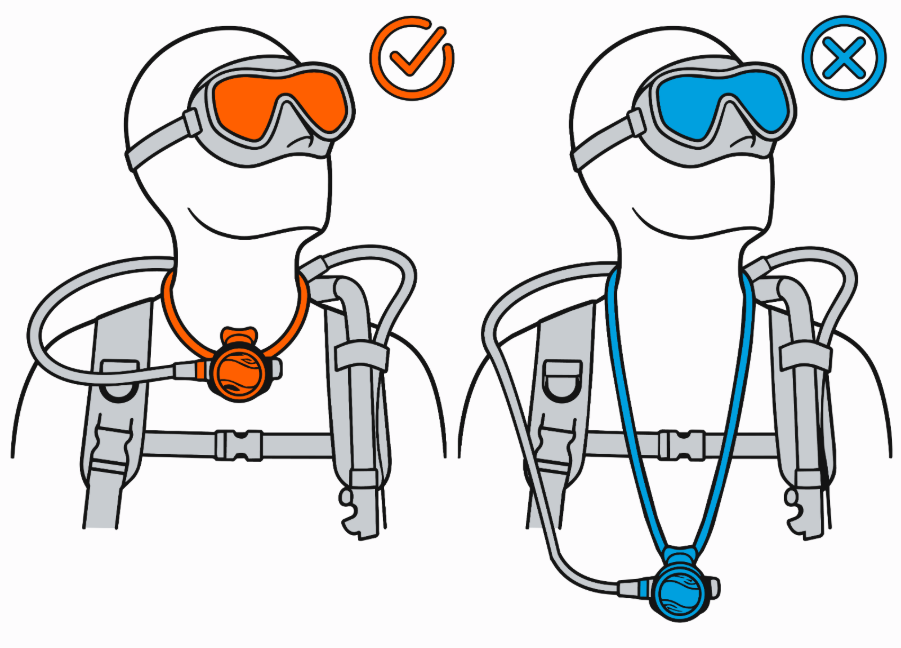
THE BUNGEE SECOND-STAGE NECKLACE
The boundaries separating recreational from technical diving get more blurred every time your favourite dive magazine drops a new copy. At one time, breathing nitrox was considered technical diving. Now divers can use nitrox on their open-water checkout dives. Diving with a twinset or independent singles (that’s sidemount in old-person speak) would have got you shown the exit from most recreational dive charters. Skills and kit configurations once venerated by cave divers alone are now normal for folks whose goal is to have a quiet, benign bimble on a reef at 10 or 12 meters.
A great example of this rec-tech barrier being kicked over is breathing the ‘long hose’ and wearing the alternate second-stage on a bungee necklace. Once, being set up like this, telegraphed a diver who followed Hogarthian philosophy – the Alpinist’s ‘less is more’ outlook on gear configuration. This was what divers who swam around in caves for fun and enjoyment did.
A little history lesson later perhaps, but right now we acknowledge that RAID promotes the long hose and bungee combo to beginners who are as far removed from cave diving as new car drivers are from competing in the Montecarlo Rally. So, why on earth do we do that? And how on earth does one do it properly?
The why of the long hose habit is simple: it makes a potentially dangerous scenario safer. It makes sharing gas, in a real-life Out-Of-Air situation, less complicated. There is no counter argument that dealing with the journey back to the surface is made less stressful when two buddies are working with the extra space and flexibility offered by being on a long hose.
But a word of caution… to enjoy the real benefits of this practice in a real emergency, make sure your bungee is the correct length and sits where it’s supposed to sit.
Skip the next couple of paragraphs if you know why that’s the case.
Placement:
- A backup regulator’s second stage should sit comfortably just under your chin or immediately below the throat. It should be loose enough to allow completely unrestricted head rotation and down-gaze, but snug enough that the regulator doesn’t swing loosely like a loose gold chain or be long enough to catch on gear. The reason why is accessibility. You should be able to get the regulator into your mouth without needing to use your hands. The argument for being able to do this is that if your hands are busy making sure your OOA buddy is all squared away with your long hose reg, you can still get something to breathe. There are a couple of subordinate reasons, but this is the major gist.
Another reason to keep the necklace short and your backup tight to your upper chest is so that, when swimming through a silty restriction, it doesn’t get dragged through the mud as you wiggle your way out. Filling a second stage with silt and mud makes breathing from it later in the dive… should you need to… difficult. Now, that’s certainly a cave-diving issue, and may not be relevant for you, but now you know.
By the way, the correct length for a bungee regulator necklace is to
begin the “manufacturing process” with about 60 to 75 cm of 4 mm to 5 mm cord. That’s about two feet of ¼ inch bungee.
Hope this helps and remember, there’s always a reason why!
LISTEN TO AN AUDIO VERSION OF THIS POST>>>