
RAID’S POSITION ON DRYSUIT DIVING…
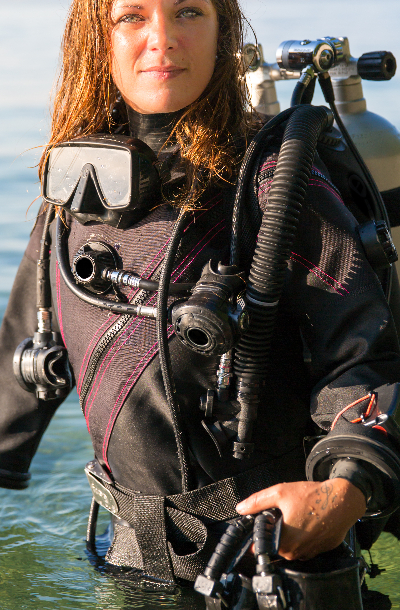
As a matter of fact, we don’t really have one. We do think drysuits can make the difference between a comfortable dive and a rotten one. And we believe that in plenty of cases, but certainly not every case, diving dry is a better way to dive. But RAID doesn’t presume to have a ‘position’ regarding their use. Just like we don’t recommend students or instructors buy a specific brand. Those are decisions we leave to the folks pulling out their wallets and handing over the cash… or credit card.
However, investing in a drysuit is a major investment and we want to help you get your money’s worth. So, we do have a handful of suggestions and tips. If you’re interested in those, read on…
The majority of casual divers — the industry’s backbone — take one or two dive trips a year and log 20 to 30 dives in tropical or semi-tropical water. A good quality wetsuit worn over a comfortable rash guard probably provides all the protection they need. However, a growing number of recreational divers are getting into the water more often and exploring sites in cool or even cold water. This is drysuit territory. In this scenario, getting into a drysuit expands the horizon and brings the magic back to what for most of us is “local” diving.
So, if your decision is to buy a drysuit the first suggestion is to make sure that it fits. If you are lucky enough to find one off the rack, great! If not, find a manufacturer that can supply a ‘bespoke’ or custom-made suit. This increases the initial cost, but there is little point in spending money on one that’s too big (it’ll trap air and be a challenge to control) or too small (which will restrict movement and be uncomfortable in every position).
Most important when testing fit is to remember that a drysuit’s function is to keep water out. Thermal protection — even in a neoprene suit and certainly in a trilaminate — is the job of thermal underwear. Wear it when trying on suits.
Trilaminate and neoprene? Probably the next question to answer is what material to choose for a drysuit. The top brands tend to be either Trilaminate — a waterproof membrane, sandwiched between an outer and an inner layer of durable material like nylon or polyester — or crushed neoprene — the synthetic, closed-cell rubber most divers are familiar with as wetsuit material. There are other materials but most are made from one or the other… and occasionally a marriage of both.
Trilam suits offer flexibility, lighter weight for travel, and excellent drying speed, but require more undergarment layers for warmth. Crushed neoprene suits provide some inherent insulation, reducing the need for extensive layering, are more rugged and tend to have a more streamlined, integrated feel, but they are heavier.
In a perfect world, you can look at, feel, and even dive both. Each has its champions. Something that may be important to you is that many trilam suits and few neoprene ones feature self-entry waterproof zippers. These are in the front across the torso rather than across the shoulders. Something to think about and a deciding factor for some.
A quick note on ankle weights trilam or neoprene: don’t. If someone suggests using these to compensate for floaty legs, resist. This is not the place for a lesson in the basics of inertia/weight/ mass but putting a kilo ankle weight at the end of your legs is going to add an appreciable workload and is going to negatively affect your trim especially at rest. If the suit’s legs are baggy, it doesn’t fit. If you’re stuck with a suit with baggy legs, invest in a pair of gaiters.
The importance of drysuit underwear’s CLO — a measurement of its ability to keep you warm — is a topic for a future blog post. However, for the time being, one of the ‘RAID Tips’ for drysuit diving is match your thermal undies with the water temps you expect to dive in. The same drysuit that works in four degrees will work equally well in twenty-four; the difference would be the use of thin polypropylene ski undies compared to thick polyester fleece or goose down!
Next on the suggestion list is another aspect of fit but this time it’s about checking wrist and neck seals. These are obviously two (well, three) potential points of leaks. The common options are latex, silicone, and neoprene. Each has benefits, each has its specific challenges whether durability or efficiency when keeping water on the outside. Do your research. One neat option is to have seals that can be repaired or replaced in the field.
Modern drysuits are fitted with dependable valves to let gas in or out. Most drysuit companies use models made by the same three or four brands. The only suggestion there is to keep valves clean and test they work as they should before every dive.
Another thing to consider is what gas to use to inflate your drysuit? The pros and cons of introducing argon into the equipment choices are an active debate. Our position is that the downside of the accidental introduction of argon into a diver’s breathing gas, far outweigh the potential thermal benefits. Use air.
Yet another choice is what accessories match your diving. Drygloves, neoprene gloves (thick or thin), or no gloves. A double hood, a thin 3 mm one, or a nylon/polyester blend beanie. Again, it depends on where you dive. Each has its place and the answer is probably one of each if you travel.
Finally there is the value of taking a drysuit course. We obviously consider this a no-brainer. The RAID course has value because it’ll take out the potential challenges of trail and error… which is not the best approach to building dive experience. In practical terms, doing the course will show you how to use and look after your suit. Also, taking a course will save you time because it’ll help you to get comfortable and proficient with your new gear quickly. Just as important, it will show you what to practice and how!