

TAKING IT IN YOUR STRIDE
One of the biggest fears divers have is gear giving up the fight and failing to work during a dive. This according to a recent survey from an online scuba magazine. Unfortunately, the survey did not specify what type of equipment failure was top of the list. One would imagine that, given the option, most of us would prefer to deal with a broken fin strap on the surface rather than a regulator first stage falling to pieces at 30 metres. But the survey left that to the reader’s imagination.
So, let’s look at the situation for ourselves, logically. What’s bad and what’s reasonably easy to avoid… or at least easy for a diver to lessen its likelihood with the least effort.
Scuba gear is made to pretty high standards. The chances of a piece of kit from any major manufacturers failing without the encouragement of neglect is small. And, if it’s looked after — and not fiddled with as a DIY project — the chances of a major equipment failure doing real damage to the environment or the diver themselves is rare. Statistically, the real problem isn’t the gear breaking, it’s the diver’s reaction to it breaking. But that’s a blog post for another day,
The golden rules concerning dive gear is that it’s serviced, suitable, simple, streamlined, and standard. Nothing remarkable there, and it’s proven to be great advice.
Here are those points in some detail.
Serviced means just that. Basically, if it has moving parts, it probably has a warranty and that warranty will usually be somehow tied to a regular service schedule. This ‘rule’ covers regulators, inflation and dump valves on wings and BCDs, tank valves, and let’s also include anything with batteries… a PDC or lights for instance.
Suitable, simply means that whatever the piece of kit is, it was made specifically to do the job it’s being asked to do. For example, it would be unrealistic and unwise to expect a cheap boltsnap from a corner hardware store to last more than one or two uses in the ocean. Stainless steel ones are expensive because they’re fit for purpose. That purpose being diving. Same thing goes for life-support. It should come as no surprise a cut-price regulator first stage built for recreational warm-water reef diving is not the best tool for a dive under ice.
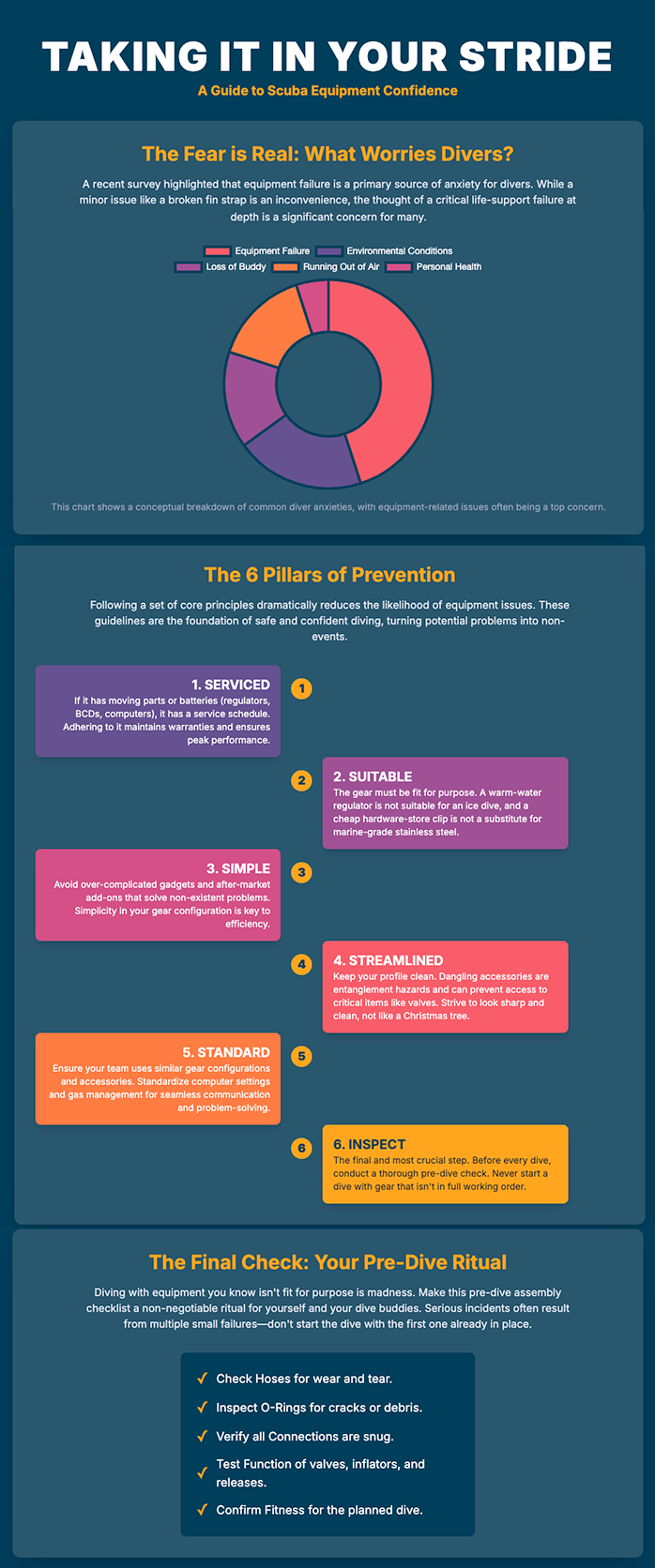
Simple and Streamlined really work together. Over-complicated do-dads and after-market gadgets do not belong on dive gear. To quote a RAID mantra, these items are usually solutions to non-existent problems. Keep gear simple and uncomplicated by “innovative ideas” that just add bulk and unnecessary complexity.
Combo surface alert sirens combined with drysuit inflators, featuring a built-in taco warmer, are absolutely things to avoid. So too is anything that has the potential to get in the way of accessing something critical, such as a valve or dump-valve. A diver carrying every reel, light, spool, notepad, and accessory in the ACME dive catalogue may win prizes as a facsimile Christmas tree ornament but they would also be breaking the simple and streamlined guideline. Strive to look sharp and clean.
Standard has a double meaning. Firstly, it’s best for all members of a dive team to be carrying similar gear configured in the same way as each other. This extends from where accessories are kept — pockets, pouches and the like — to what they are. Keep tools and required accessories the same throughout the team… where possible. Secondly, standard also covers dive computers, their settings, and of course what gases are being breathed and how much of those gases is being carried.
Sticking to these five guidelines can’t guarantee things will not break but following them will help cut down the confusion when things do go pear-shaped.
And of course, there is one more to add to this list. And that’s RESPECT & INSPECT YOUR GEAR.
During assembly, check hoses, o-rings, connections, function, and fitness. Starting a dive, ANY dive, with a piece of kit that is not in complete and in full working order is nuts. Knowing that something isn’t fit for purpose but taking it into the water is madness. Look at your gear but also make sure other divers in the water with you have looked theirs over too.
Following pre-dive assembly checklists and fit-to-dive inspections should always be done by everyone on dive day. Serious incidents are often the result of multiple system failures. Don’t tempt fate by starting a dive knowing the first of them has already happened.
Now about a diver’s reaction to something breaking being a problem. RAID has a course specifically designed to help with that… INDEPENDENT DIVER. Check it out.